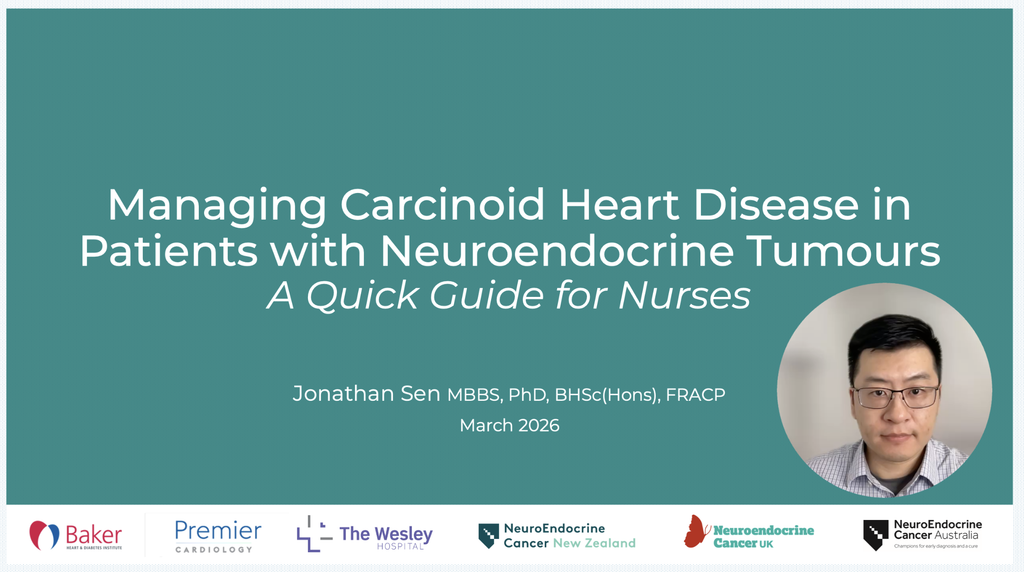
I recently presented a webinar on carcinoid heart disease for the Will Norman Nurse Webinar series, a collaboration between NeuroEndocrine Cancer Australia and its counterpart organisations in New Zealand and the UK. I wanted to share a few reflections on why this topic matters so much to me, and point nurses and other health professionals to the recording.
Neuroendocrine tumours, or NETs, are uncommon but not as rare as many people think. Between 19% and 4% of NET patients develop carcinoid syndrome, the flushing, diarrhoea and bronchospasm caused by vasoactive substances entering the bloodstream. Of those, somewhere between 25% and 50% will develop carcinoid heart disease, where serotonin damages the right-sided heart valves and eventually leads to heart failure. It is the leading cause of morbidity and mortality in the carcinoid syndrome population, and untreated, it carries a three-year survival of just 31%.
Those numbers alone justify an entire webinar. But there were two reasons I found this session particularly worthwhile.
The condition hides in plain sight
The first is that carcinoid heart disease is silent for a surprisingly long time. Up to 60% of patients with moderate to severe tricuspid regurgitation have no cardiac symptoms at all, and about a third have no murmur. The heart compensates until, quite suddenly, it cannot.
Meanwhile, fewer than 42% of patients who meet screening criteria actually receive the echocardiogram they should be getting. Without active screening, diagnosis can be delayed by a year and a half or more.
The clinicians closest to these patients, at the bedside, in the clinic, and on the phone, are the ones most likely to notice new breathlessness, new oedema, or creeping fatigue in a patient with carcinoid syndrome. In the webinar I covered the two screening biomarkers worth knowing cold: 5-HIAA, with a threshold of 300 micromoles per 24 hours, and NT-proBNP, where a level above 260 picograms per mL has around 90 percent sensitivity and specificity, and a normal value makes the condition very unlikely.
The damage cannot be undone
The second reason is sobering. No current therapy can reverse the fibrotic valve damage once it is established. Prevention and early control are everything: somatostatin analogues to suppress serotonin, telotristat where diarrhoea remains refractory, and careful surveillance in between. When the disease does progress, valve replacement surgery remains the only definitive treatment, and it brings its own challenges, including perioperative protection against carcinoid crisis with intravenous octreotide started well before induction.
There is genuine reason for optimism on the horizon. Trials such as TELEHEART, which is testing whether telotristat can improve cardiac biomarkers in these patients, and emerging transcatheter approaches for those too high-risk for redo surgery, were among the developments I discussed toward the end of the session.
Recording available here
The webinar runs through all of this in a practical format: recognising early symptoms, coordinating screening, medication administration, patient education, and keeping the multidisciplinary team talking to each other.
You can watch it, free of charge, through NeuroEndocrine Cancer Australia’s Health Professionals resources page, under the Will Norman Nurse Webinar series. I would particularly recommend it to nurses working in oncology, gastroenterology, or cardiology settings, and to anyone caring for patients with NETs.
If you are a clinician with questions after viewing, my contact details are on my website, and I am always glad to talk about NETs and the heart.